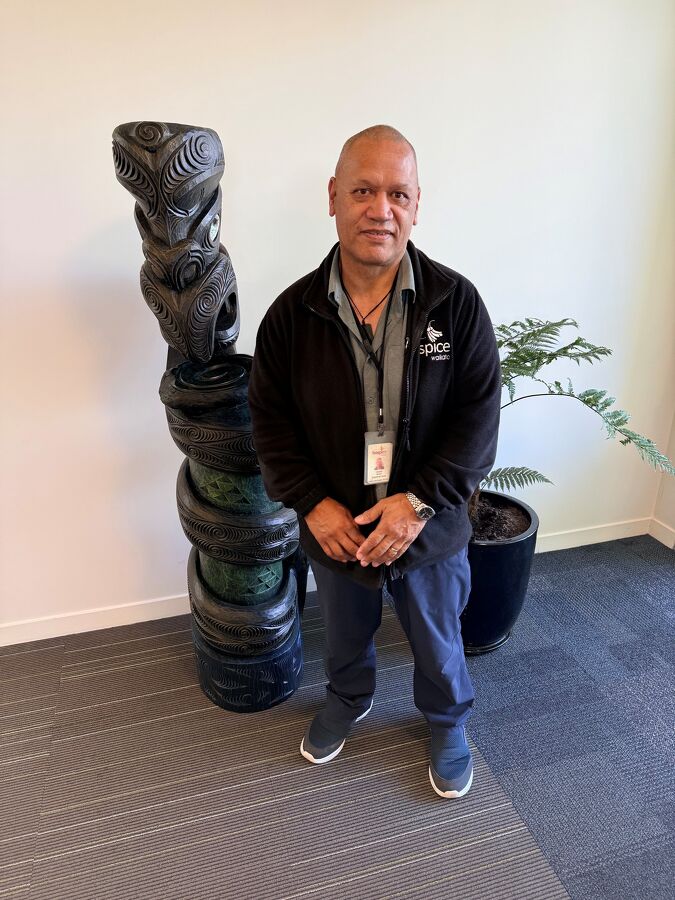
Duty of Care: A lifetime of walking alongside his people
Date: 30 Sep 2026
When Howie talks about nursing, he doesn't talk much about himself.
Instead, he talks about people.
The patients who welcomed him into their homes. The whānau who trusted him. The colleagues who supported him. The student nurses finding their feet. The communities he has worked alongside throughout a career that has spanned more than four decades.
Now, as he prepares to leave Hospice Waikato and move to Western Australia to be closer to one of his sons and his grandson, he reflects on a nursing career shaped by relationships.
"It's my duty of care to my people. To keep them safe."
For Howie, that sense of responsibility has always been important.
One of 12 children, he grew up at a time when te reo Māori wasn't widely spoken. Like many Māori of his generation, his connection to language and culture deepened later in life. Over the years he has learned tikanga, strengthened his understanding of te ao Māori and developed a strong appreciation for the role culture plays in wellbeing and care. One of his greatest joys is hearing his grandchildren speak his language fluently.
It was back in the 1980’s, after training as a nurse, Howie headed to the United Kingdom, where he worked in London hospitals including St Mary's and St Thomas'. Eventually he returned home to New Zealand, raising "his boys" while working night shifts in a respiratory ward at Waikato Hospital.
It was there that a manager suggested he might enjoy community nursing.
She was right.
Working first as an agency nurse and later in diabetes services across Ngāruawāhia and Huntly, Howie discovered what would become the most rewarding part of his career: getting to know people and their whānau.
"It was all about relationships," he says. "Whānau are part of the journey."
Families appreciated his clinical knowledge, but they also valued his calm manner, his deep respect, his honesty and his willingness to take the time needed to understand what mattered most to them.
At Raukura Hauora, working with people living with chronic illness, he found an approach that resonated deeply with him. Tikanga Māori was woven naturally through the organisation's work, and he valued being able to provide care in a way that reflected the needs of both patients and whānau. He also had the privilege of supporting some of those closest to the Kīingitanga.
It was there he worked alongside Hospice Waikato Community Nurse Jenni Bell, supporting patients whose conditions had become palliative.
Jenni encouraged him to consider joining Hospice Waikato.
For Howie, the move felt like a natural next step.
Here he found the opportunity to nurse in the way he enjoyed most, working independently, building trust and supporting people through some of life's most challenging conversations and decisions.
One patient has stayed with him over the years.
She was a woman in her fifties who understood her illness well and wanted to spend her final days at home, despite recommendations that she remain in the Inpatient Unit. Howie listened. He advocated for her wishes, working with those around her to make it happen.
She died peacefully at home.
For him, it was a reminder of the importance of listening and of helping people retain dignity at the end of life, things that are at the heart of hospice care.
Throughout his career, those moments have mattered.
At Hospice Waikato he found not only meaningful work, but a team he trusted. He valued the support of managers, the friendships formed with colleagues and the opportunity to debrief with people who understood the realities of palliative care.
He has also enjoyed seeing Hospice Waikato begin its own tikanga journey through the implementation of its Māori strategy, Te Kāhu Taurima, and strengthen cultural capability across the organisation.
While caring for patients has always been at the heart of his work, Howie has thrived on supporting student nurses completing placements with Hospice Waikato. He believes life experience is important in palliative care and has valued being able to share what he has learned along the way.
As he prepares for life in the Australian outback, Howie isn't planning to step away from nursing just yet. There are still communities to support and new relationships to build.
Leaving Hospice Waikato will be difficult. “Friendships are important, and I never liked saying goodbye," he admits.
Looking back, he is proud of the work he has been part of, both within hospice and throughout a career spent walking alongside people when they needed support most.
His assessment of Hospice Waikato is typically understated.
"We do our part pretty good."
It's a simple comment, and perhaps one that reflects Howie's approach to nursing too. Quietly getting on with the job. Taking time. Building trust. Caring for people well.
And in doing so, making a difference to countless patients, whānau and colleagues along the way.